local knowledge
Local knowledge and culture had roughly twice the topic share in Bambara as in French
In Kabakoo’s AI-learning conversations, endogenous knowledge and culture-related topics accounted for 10.5% of topics in Bambara and 5% in French. Learners’ movement between languages, alongside distinct voice and text patterns, gives that comparison its context.
A different topic mix in each language
Local knowledge occupied a larger share of the discussion when learners interacted with Kabakoo’s AI Mentor in Bambara. Endogenous knowledge and culture-related topics accounted for 10.5% of topics in Bambara, compared with 5% in French—roughly twice the share.
For digital-tech topics, the pattern ran in the other direction: 13% in French, compared with 3% in Bambara, or about four times the share. The contrast concerns the composition of conversations in each language, rather than which language generated more conversations overall.
These findings connect language choice with the knowledge learners discussed. They show an association, not that using a particular language caused a particular topic to emerge.
Learners used both languages
The people behind these conversations did not fall into neatly separate language groups. Roughly 77% of learners who used Bambara also used French. They moved between the languages depending on what they were trying to do.
That overlap is central to understanding the topic comparison. The Bambara conversations were not simply the activity of an exclusively Bambara-speaking group set against an exclusively French-speaking one. Many learners used both languages within their interactions with the AI Mentor.
The resulting picture combines bilingual participation with different topic shares: local knowledge and culture featured more prominently in Bambara, while digital and technical subjects featured more prominently in French.
Voice and text followed distinct patterns
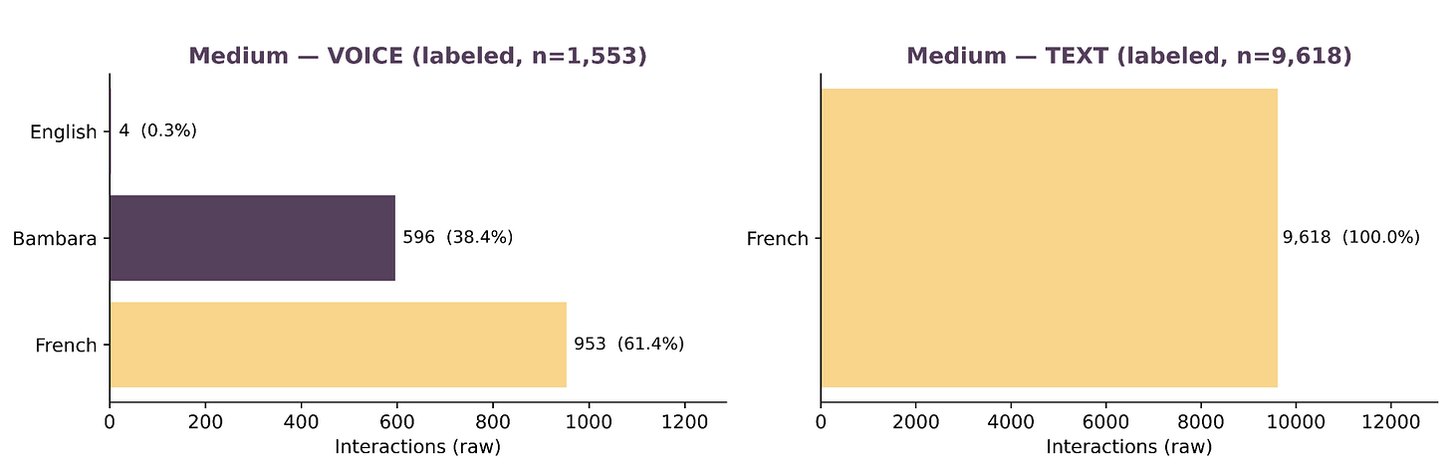
Language use also differed by format. Written exchanges remained overwhelmingly French, while nearly 40% of voice interactions took place in Bambara. Alongside movement between languages, learners therefore showed distinct patterns in spoken and written interaction.
A separate Kabakoo TVET digitization project provides context for that distinction. Learners in that project wanted oral explanations in Bambara, yet 92% reported difficulty reading it, and half could not read it at all.
Wanting to hear an explanation in Bambara and being able to read that explanation were different needs. The TVET findings make that difference concrete, while the AI Mentor observations show how strongly language use varied between voice and text.
Local knowledge within bilingual AI use
Read together, the observations describe more than a choice between Bambara and French. They encompass learners switching languages, a predominantly French written channel, a substantial Bambara presence in voice, and a different balance of topics in each language.
Kabakoo’s June 2026 update on bilingual AI learning and local knowledge brings these patterns together. Its central finding is specific: endogenous knowledge and culture held a larger share of topics in Bambara, within a learning environment where many Bambara users also used French.